The Power of Brainstorming: Why You Need to Write Your Ideas Down
Michael Schuneman
Monday, December 13, 2021

NOTE: This post may contain affiliate links. That means if you purchase something through the link, at no additional cost to you, I could be paid a commission. I only recommend things I trust and would recommend anyways.
As I was reflecting on the week and thinking about what I was going to write about, my 11-year-old son came in complaining about a short essay he needed to write.
He was grumbling that he didn’t know what to write.
Have you ever felt that way?
You sit down with a blank page in front of you, and suddenly your mind feels blank, too. You know you have something to say, but you can’t seem to pull the words out.
I asked my son what his essay topic was. Then I told him to brainstorm some ideas or points about that topic.
He told me one thing.
Then he said he couldn’t think of anything else.
So I told him to go write that one idea down on a piece of paper. I told him not to worry about writing the entire essay yet. Just write down the different ideas that came to mind.
He didn’t need a polished introduction.
He didn’t need perfect paragraphs.
He just needed to get started.
After he left, I got to thinking about the power of brainstorming, and how important it is to write things down.
It’s something I could be better at myself.
I can’t tell you how many times I have thought of an amazing idea for something and didn’t write it down. Later, when I needed the idea again, it was gone.
Completely gone.
I couldn’t think of it if my life depended on it.
That’s why I want to remind you, and remind myself, to write your ideas down.
Brainstorming gives your thoughts somewhere to go
When an idea stays in your head, it can feel exciting for a moment.
You think, “That’s a great idea. I’ll remember that.”
But life gets busy. Another conversation happens. You answer an email. You run an errand. You help a customer. You get distracted by something else.
Then the idea disappears.
Writing it down gives that idea somewhere to live.
It doesn’t have to be in a fancy notebook. It doesn’t have to be organized perfectly. You can use a piece of paper, a notes app, a shared document, or whatever is close by.
The important thing is to capture it before it gets away.
This is especially important when you run a small business.
You might suddenly think of:
- A helpful blog post your customers need
- A social media video you could record
- A new headline for your website
- A free checklist you could offer
- A better way to explain your product
- A question your customers keep asking
- A new service or offer you could create
If you don’t write those ideas down, you may never see them again.
And sometimes the idea that seems small at first becomes the seed for something much bigger.

Write down every idea, even the strange ones
When you brainstorm, write every idea that comes to mind.
I mean every idea.
Don’t immediately decide that something is stupid, ridiculous, odd, or impossible. Don’t shut down an idea before you have given it a chance to exist on paper.
That is part of the process.
Brainstorming is not the same thing as making a final decision. It is not the same thing as choosing the best idea. It is simply a way to get possibilities out of your head.
You can evaluate the ideas later.
During the brainstorming stage, your only job is to create options.
I have found that when I try to ignore ideas because I don’t think they are very good, they have a tendency to stick around. They keep taking up space in my mind.
But when I write them down, I can let them go.
Once the idea is on paper, I can move on to the next one. And sometimes that next idea is much better.
The first idea may be a doorway to the second idea.
The strange idea may lead to the practical idea.
The idea that seems too simple may help you discover the message your customers have been waiting to hear.
So don’t edit while you brainstorm.
That comes later.
Your first marketing idea doesn’t have to be perfect
Many small business owners struggle with marketing because they believe every message has to be perfect before they share it.
I understand that temptation.
You care about your business. You care about your customers. You want to say the right thing and represent your product or service well.
But perfection can turn into paralysis.
You end up staring at a blank screen instead of writing the first sentence.
What if you took the same approach I suggested to my son?
Instead of trying to write the entire blog post, start by listing a few ideas.
If you need content ideas, ask yourself:
- What questions do my customers ask me most often?
- What mistakes do people make before they find my business?
- What do I wish every potential customer understood?
- What problem does my product or service solve?
- What do people misunderstand about my industry?
- What story could help someone feel less alone?
- What lesson have I learned the hard way?
Write down every answer.
Don’t worry about whether the answers are polished. You are building a pile of raw material.
Later, you can sort through it and decide which idea should become a blog post, email, video, social media post, or lead magnet.
You don’t have to create everything at once.
You just need to stop expecting one perfect idea to appear fully formed.
Brainstorming can help you create better offers
Brainstorming is also useful when you are trying to figure out what to sell.
Maybe you have a good product or service, but your offer isn’t connecting with people. Maybe you know you can help, but you’re struggling to explain the value clearly.
Start writing.
List the problems your ideal customer is facing. List the frustrations they have already told you about. List the things they have tried that didn’t work.
Then brainstorm ways you could help them take the next step.
Your notes might eventually become:
- A simple introductory offer
- A free guide
- A short email course
- A consultation
- A workshop
- A checklist
- A sales page
- A sequence of helpful emails
For example, if your customers are confused about how to market their business online, you might brainstorm a short guide that walks them through the basics.
If you want to turn that guide into a simple funnel, ClickFunnels can give you tools for creating landing pages, follow-up steps, and an offer pathway.
But don’t begin by worrying about the technology.
Begin with the ideas.
What does your customer need? What would make their life easier? What could you explain in a clear and helpful way?
Write it all down first.
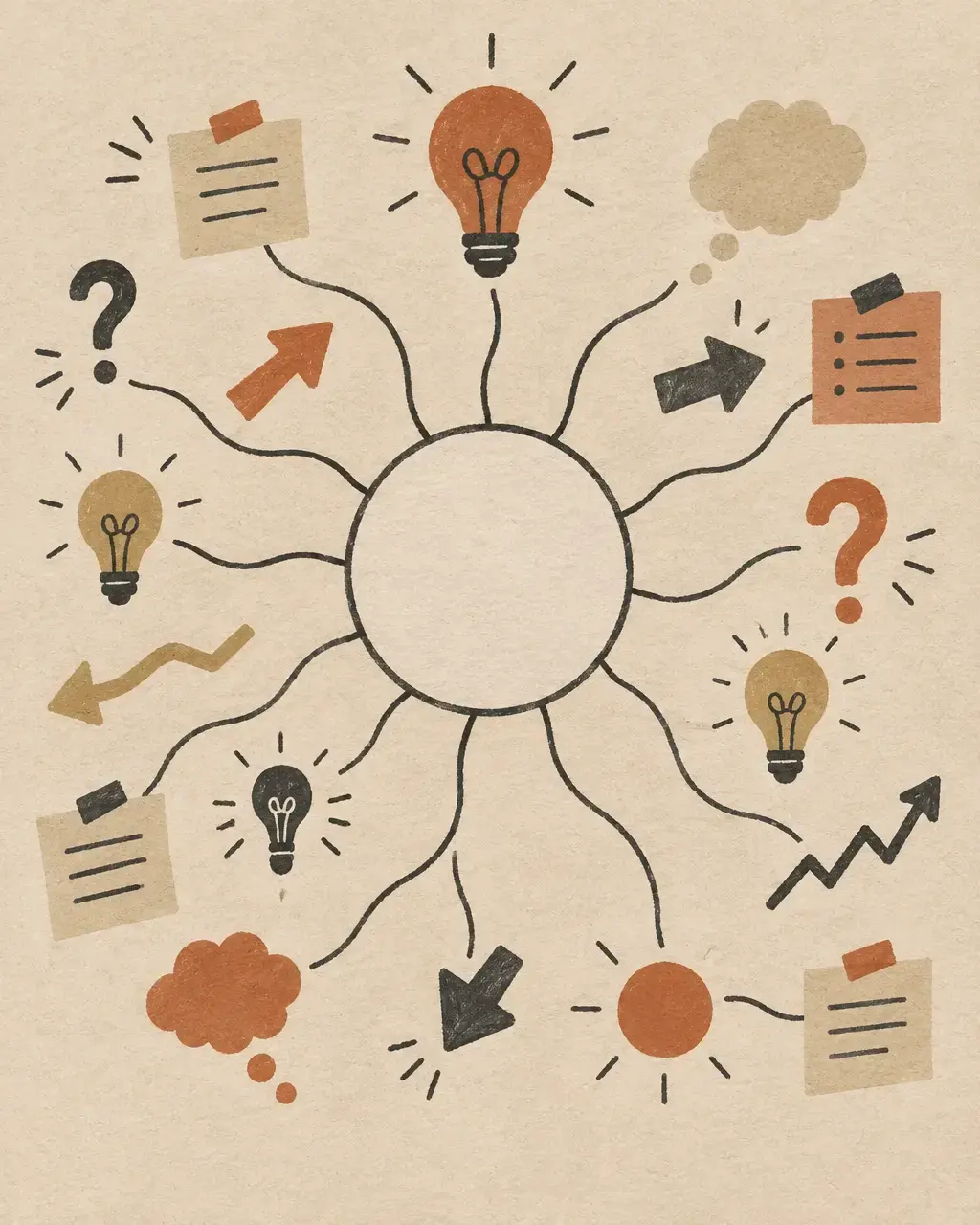
A simple brainstorming process you can use
Here is a process you can use the next time you feel stuck.
1. Choose one question
Don’t try to brainstorm your entire business at once.
Choose one question, such as:
- What should I write about this week?
- What does my customer need help with?
- What offer could I create?
- How can I explain what I do more clearly?
- What headline would make someone want to keep reading?
A clear question gives your thoughts something to focus on.
2. Set a short timer
Give yourself 10 or 15 minutes.
That’s long enough to generate ideas but short enough that it doesn’t feel overwhelming.
During that time, don’t stop to judge yourself.
3. Write everything down
Write the obvious ideas.
Write the unusual ideas.
Write the ideas that feel unfinished.
Write the ideas that seem too basic.
You can always cross something out later. You cannot evaluate an idea you never captured.
4. Look for connections
Once the timer ends, read through your list.
Do any ideas fit together?
Does one idea answer a question raised by another? Could three small ideas become one useful resource?
This is often where the real value appears.
Brainstorming is not just about producing a long list. It is about giving yourself enough raw material to discover connections.
5. Choose one next step
Finally, choose one idea to develop.
Not ten.
One.
Turn it into a rough outline. Write the first paragraph. Create a simple draft. Ask a customer for feedback.
The goal is to move from ideas to action.
Keep an idea library
I also recommend creating one place where you keep your ideas.
It could be a notebook labeled “Ideas.” It could be a document on your computer. It could be a folder in your notes app.
Whenever an idea comes to you, put it there.
You may not use the idea today. That’s okay.
Your idea library becomes especially valuable on the days when you feel like you have nothing to say.
You can open it and find questions, stories, headlines, offers, and lessons waiting for you.
It’s like planting a garden. You may not harvest everything immediately, but you’re giving yourself something to work with later.

Get the ideas out of your head
The biggest lesson I took from that conversation with my son is simple:
You don’t have to write the whole essay today.
You just need to write down the ideas.
The same is true for your business.
You don’t have to create the perfect marketing campaign in one sitting. You don’t have to write the perfect sales page on your first attempt. You don’t have to know exactly how every piece will fit together.
Start with a question.
Then brainstorm.
Write down every idea that comes to mind, even the ones that seem strange or incomplete. Get them out of your head so you can make room for better ideas.
If you want another exercise for getting clear about your direction and motivation, you can also check out my 15 Questions to Reignite Your Fire guide.
The next time you feel stuck, don’t stare at the blank page and wait for inspiration.
Pick up a pen.
Open a blank document.
Write down the first idea.
Then write down another one.
You don’t have to use every idea you write down.
But write it down anyway.

A short passage from James Clear’s Atomic Habits stopped Michael Schuneman in his tracks: time magnifies whatever you feed it. Discover how your daily habits can quietly move your business toward success, or farther away from it.

Faith and fear both ask you to believe something about the future, but only one helps you move forward. Explore how this choice affects everyday life, marketing, sales, and the decisions small business owners make when results are uncertain.

Have you ever tried to help someone, only to have them reject your advice? Explore why good advice can fail when people aren’t ready to hear it, and how small business owners can market more effectively by focusing on people who already recognize their problem and want help.

Hi, I'm Michael
Chiropractor · Entrepreneur · Lifelong Learner
I don't write because I've figured everything out. I write because I'm still figuring it out — and I've found that the lessons that hit hardest are usually the ones worth passing along.
This blog is where I think out loud about mindset, health, business, and what it means to build a life you're actually proud of.
Free Resource
Feeling Stuck?
This Might Help

15 questions designed to help you reconnect with your purpose and get moving again. No fluff. Just honest questions that cut through the noise.

Dr. Michael Schuneman, DC
Chiropractor · Entrepreneur · Lifelong Learner
Building wealth without selling my soul, and sharing what I've learned along the way.
CONNECT
Copyright 2023+ - Schuneman Enterprises, LLC - All Rights Reserved
3707 Parkmoor Village Dr. #101, Colorado Springs, CO 80917
